I just know some of you out there will be screaming at your monitors asking "Why didn't she give us this before??" Well, it's because she (I) didn't finish putting together the final exam until today. Also, this was NOT an easy or straightforward thing to figure out how to do.
What you see here is the same notes you had earlier, but I have put a red rectangle around the slides that are most important for answering questions on the final exam. Here is part 1--chapters 5 to 13.
I recommend that you look at this document alongside the notes I already gave you, and circle or otherwise mark the slides I have indicated as important. Part 2 will be posted as soon as I have it ready for you.
9:00 p.m. update: Part 2--Chapters 16 to Epilogue
Second update as of May 15 at 8:50 p.m. Apparently the part 2 file I uploaded yesterday was corrupted or distorted, so I'm breaking it into two parts to see if that works better. Here is chapter 16 to 21.
9:15 This is utterly absurd--it still looks hideous. I'm going to try one more thing before I give up. Either way, I still plan to go over this with you before the exam tomorow.
Part 2 of the final exam notes
Page 1
Page 2
Page 3
Page 4
Page 5
Page 6
Page 7
Page 8
Page 9
Page 10
Page 11
Page 12
Page 13
Page 14
Page 15

Showing posts with label Development. Show all posts
Showing posts with label Development. Show all posts
Tuesday, May 15, 2012


Homework (10 point papers) revisited
Here is the handout about homework that I provided on the first day of class. In this post, I will provide information about which articles and videos are appropriate for these 6 one-page papers.
I have a few specific articles that I can link you to (I will create a new post to share those with you), but you can also find articles on your own by going to the American Psychological Association web site, to “psychology topics”. Click on a subject that interests you—for example, ADHD. Scroll down the page past the first couple sections to the one labeled “News”. Any of the news articles (on any of the psychology topics) is acceptable for your 10 point papers. Below the news links, there should be the heading “Monitor on Psychology Articles”. Those are also acceptable for 10 point papers.
Here are some approved videos.
Videos
Since some people have said they had difficulty making out the video I posted, I will just mention some of the most important points here.Papers should be at least a full page typed, double-spaced. You should not just do an overall summary of one of the Psychology Topics...once you click on a topic that interests you, you should then scroll down and find an article on that topic. The article be listed under News or Monitor on Psychology Articles. I did not require APA format on the 10 point papers, but it would be a good idea to identify the title of the article or video somewhere in your paper.
Friday, May 11, 2012
10 point paper instructions--a review
Update Number Two: I posted this video for you all at the beginning of April, but based on some of the papers I have seen, I thought some of you might benefit from a reminder. I will accept one page papers on the day of the final exam, so if you are one of those students who, for example, described a disorder rather than summarizing an approved article about that disorder, there is still time for you to make some changes to your paper to bring it in line with the requirements.
I will say this next part in bold so that you don't miss it--the only material in the video below that is outdated/incorrect is the part that refers to the number of papers. You do need to write 6 one-page papers in addition to your 30 point paper. But you should listen carefully to everything else in the video, because it is still accurate and is important.
4/3/12 Update: I created this video at the end of winter quarter in response to some common mistakes that were showing up in the 10 point papers as I began to grade them. At some point in the video I made reference to the fact that one class needed to write 6 of these papers, while the other class only needed to write 4. This quarter, all of my classes will be writing 6 of these papers. But everything else in the video remains accurate, and it should be helpful to watch if you are confused at all about the 10 point homework papers.
Based on some issues I've seen while grading the 10 point "mini-papers", I decided to put together this PowerPoint video to remind everyone of the instructions. I will not be giving anyone who actually turned in a paper a zero, but you should not expect to receive full credit for a paper if you did not follow the guidelines described here.
I will say this next part in bold so that you don't miss it--the only material in the video below that is outdated/incorrect is the part that refers to the number of papers. You do need to write 6 one-page papers in addition to your 30 point paper. But you should listen carefully to everything else in the video, because it is still accurate and is important.
4/3/12 Update: I created this video at the end of winter quarter in response to some common mistakes that were showing up in the 10 point papers as I began to grade them. At some point in the video I made reference to the fact that one class needed to write 6 of these papers, while the other class only needed to write 4. This quarter, all of my classes will be writing 6 of these papers. But everything else in the video remains accurate, and it should be helpful to watch if you are confused at all about the 10 point homework papers.
Based on some issues I've seen while grading the 10 point "mini-papers", I decided to put together this PowerPoint video to remind everyone of the instructions. I will not be giving anyone who actually turned in a paper a zero, but you should not expect to receive full credit for a paper if you did not follow the guidelines described here.
Wednesday, May 9, 2012
Monday, May 7, 2012
Possible Links of Interest
I am working on grading, as well as preparing the final lecture for Human Growth and Development before next week's final exam--you know, picking out the really important material that shouldn't be left out of a course like this. And, of course, making sure that the final exam reflects that focus. (Note to my Intro students--you all did an outstanding job on the final exam, so no worries there!)
Anyway, while I was looking through the folders on my desktop, I came across some pages of "web resources" that I found on one of the textbook companion sites (instructor edition). Nothing here is required reading, but I thought it would be remiss to end the quarter without passing these along. You may wish to take a quick peek at the links and see if any of them might be useful to you at some point in the future...either professionally or personally...and bookmark those for later reading.
First and foremost--I promised a student that I would look into this, and then it slipped my mind. Better late than never, I hope...?
Morning Sickness
Morning Sickness Protects Mothers and Unborn
The Biology of Morning Sickness (from Discover Magazine)
Morning Sickness Regulates Diet (from BBC News)
More LinksThe Nurture Assumption Home Page
The Preventative Ounce (about temperament)
The Darwin Awards (just for fun and NOT to be taken seriously!)
The Brain And Nervous System
Neuroscience for Kids (NOT as simplistic as it sounds!)
Neuropsychology Central
Comparative Mamalian Brain Collections
The Whole Brain Atlas
Consciousness
National Sleep Foundation
Facts on Tap (alcohol)
Straight Talk on Alcohol and Other Drugs
International Association for the Study of Dreams
Perception
Bad Human Factor Designs
Impossible Figures in Perceptual Psychology
Blindsight: Seeing What You Don't See
Illlusion Works
Magic Eye Site
Gallery of Illusions
The Invisible Gorilla
To be continued (and feel free to add any of your favorite "safe for work" links in the comments).
Anyway, while I was looking through the folders on my desktop, I came across some pages of "web resources" that I found on one of the textbook companion sites (instructor edition). Nothing here is required reading, but I thought it would be remiss to end the quarter without passing these along. You may wish to take a quick peek at the links and see if any of them might be useful to you at some point in the future...either professionally or personally...and bookmark those for later reading.
First and foremost--I promised a student that I would look into this, and then it slipped my mind. Better late than never, I hope...?
Morning Sickness
Morning Sickness Protects Mothers and Unborn
The Biology of Morning Sickness (from Discover Magazine)
Morning Sickness Regulates Diet (from BBC News)
More LinksThe Nurture Assumption Home Page
The Preventative Ounce (about temperament)
The Darwin Awards (just for fun and NOT to be taken seriously!)
The Brain And Nervous System
Neuroscience for Kids (NOT as simplistic as it sounds!)
Neuropsychology Central
Comparative Mamalian Brain Collections
The Whole Brain Atlas
Consciousness
National Sleep Foundation
Facts on Tap (alcohol)
Straight Talk on Alcohol and Other Drugs
International Association for the Study of Dreams
Perception
Bad Human Factor Designs
Impossible Figures in Perceptual Psychology
Blindsight: Seeing What You Don't See
Illlusion Works
Magic Eye Site
Gallery of Illusions
The Invisible Gorilla
To be continued (and feel free to add any of your favorite "safe for work" links in the comments).
Wednesday, May 2, 2012
Tuesday, May 1, 2012
Monday, April 30, 2012
Growth and Development Quiz 3
Here is the list of terms/concepts. You'll notice that it includes some concepts that were on the list for Quiz 2, but which were not included in that quiz.
Wednesday, April 18, 2012
Our new addition
This handsome young fellow came home with me last night. Cat Girl is most displeased.

This was his description on the shelter web site:
Perkins story is one of those "tear-jerkers"- his owner passed away & no one else had room for this big, lovable teddy bear. So he came to us, & as is true for most dogs, he's very glad for every Volunteer who comes in to take him out for a walk or just sits in his cage & hangs out with him. But he would be happiest with a home of his own where he can lay on the couch(or on the floor) & watch basketball games or car racing. And a dog biscuit every now & then would make him ecstatic.
Tuesday, April 17, 2012


Growth and Development Final Exam Concepts (in progress)
Wednesday, April 11, 2012
Growth and Development Quiz 2
Growth and Development Quiz 2 Concepts
Some of the Chapter 6 concepts are from a language handout that some of you may have missed. More details to follow.
Some of the Chapter 6 concepts are from a language handout that some of you may have missed. More details to follow.
Tuesday, April 10, 2012
Homework
Here is the handout about homework that I provided on the first day of class. In this post, I will provide information about which articles and videos are appropriate for these 6 one-page papers.
I have a few specific articles that I can link you to (I will create a new post to share those with you), but you can also find articles on your own by going to the American Psychological Association web site, to “psychology topics”. Click on a subject that interests you—for example, ADHD. Scroll down the page past the first couple sections to the one labeled “News”. Any of the news articles (on any of the psychology topics) is acceptable for your 10 point papers. Below the news links, there should be the heading “Monitor on Psychology Articles”. Those are also acceptable for 10 point papers.
Here are some approved videos.
Videos
Tuesday, April 3, 2012
Finding articles using PubMed
For both Introductory Psychology and Psychology of Growth and Development, there is a 30 point paper due at the end of the quarter. The specifics of the assignments are different, but both require at least one scholarly/empirical article as a reference. The instructions below are designed to explain how to find such an article for your paper.
This guide to finding articles using PubMed is available at the library. This link takes you to the library page on the AIAM web site (found under "Resources"). If you have a Columbus (or Worthington, or Westerville...) library card, you can access premium resources, like EBSCO. Whether you are using PubMed or one of the premium services, be sure to click the "full text articles" box when doing your search.
This guide to finding articles using PubMed is available at the library. This link takes you to the library page on the AIAM web site (found under "Resources"). If you have a Columbus (or Worthington, or Westerville...) library card, you can access premium resources, like EBSCO. Whether you are using PubMed or one of the premium services, be sure to click the "full text articles" box when doing your search.
Wednesday, March 28, 2012
Some notes about development
Theoretical Issues: Ongoing Debates


Prenatal development

Early motor development
 Cognitive Development
Schema –cognitive structures or patterns consisting of a number of organized ideas that grow and differentiate with experience
Assimilation – absorbing new information into existing schemas
Accommodation – adjusting old schemas or developing new ones to better fit with new information

Piaget's Stages of Cognitive Development
Sensorimotor stage
Birth to about age 2
Child relies heavily on innate motor responses to stimuli
Mental representations
Object permanence
Preoperational stage
--About age 2 to age 6 or 7
--Marked by well-developed mental representation and the use of language
Egocentrism (video)

Animistic thinking

Concrete Operational Stage
--About age 7 to about age 11
--Child understands conservation but is incapable of abstract thought
Conservation
Formal Operational Stage
--From about age 12 on
--Abstract thought appears


Theory of Mind
 Imprinting (Konrad Lorenz)
Harlow's attachment study
Mary Ainsworth's Strange Situation
Temperament –An individual’s characteristic manner of behavior or reaction
Socialization –The lifelong process of shaping an individual’s behavior patterns, values, standards, skills, attitudes and motives to conform to those regarded as desirable in a particular society
Most approaches to child rearing fall into one of the following four styles:
Authoritarian parents: parenting style emphasizing control and obedience
Authoritative parents: parenting style blending respect for a child's individuality with an effort to instill social values
Permissive parents: parenting style emphasizing self-expression and self-regulation
Uninvolved parents
Erikson’s Psychosocial Stages (see handout)
Kohlberg’s Stages of Moral Reasoning
I. Preconventional morality
II. Conventional morality
III. Postconventional (principled) morality
Chapter 5 part 1
Chapter 5 part 2
Chapter 6 part 1
Chapter 6 part 2
Chapter 6 part 3
Chapter 7 part 1
- Nature versus Nurture
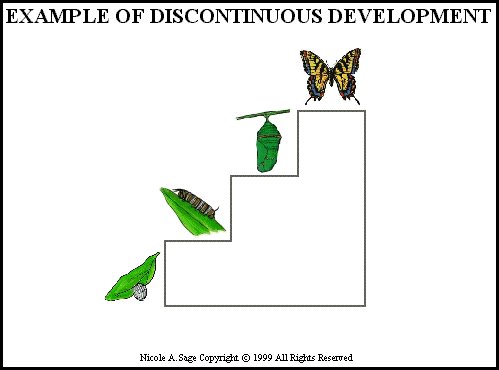
- Continuity versus Stages
- Stability versus Change



Prenatal development
- Germinal period
- Embryonic period

Fetal period

Early motor development

Schema –cognitive structures or patterns consisting of a number of organized ideas that grow and differentiate with experience
Assimilation – absorbing new information into existing schemas
Accommodation – adjusting old schemas or developing new ones to better fit with new information

Piaget's Stages of Cognitive Development
Sensorimotor stage
Birth to about age 2
Child relies heavily on innate motor responses to stimuli
Mental representations
Object permanence
Preoperational stage
--About age 2 to age 6 or 7
--Marked by well-developed mental representation and the use of language
Egocentrism (video)

Animistic thinking


Concrete Operational Stage
--About age 7 to about age 11
--Child understands conservation but is incapable of abstract thought
Conservation
Formal Operational Stage
--From about age 12 on
--Abstract thought appears


Theory of Mind
Imprinting (Konrad Lorenz)Harlow's attachment study
Mary Ainsworth's Strange Situation
Temperament –An individual’s characteristic manner of behavior or reaction

Socialization –The lifelong process of shaping an individual’s behavior patterns, values, standards, skills, attitudes and motives to conform to those regarded as desirable in a particular society
Most approaches to child rearing fall into one of the following four styles:
Authoritarian parents: parenting style emphasizing control and obedience
Authoritative parents: parenting style blending respect for a child's individuality with an effort to instill social values
Permissive parents: parenting style emphasizing self-expression and self-regulation
Uninvolved parents
Erikson’s Psychosocial Stages (see handout)
Kohlberg’s Stages of Moral Reasoning
I. Preconventional morality
II. Conventional morality
III. Postconventional (principled) morality
Chapter 5 part 1
Chapter 5 part 2
Chapter 6 part 1
Chapter 6 part 2
Chapter 6 part 3
Chapter 7 part 1
Subscribe to:
Posts (Atom)